

1. Highlighting 6D Playbook
Define the Problem
Despite the intensified preventive efforts by the Central Narcotics Bureau (CNB) and the National Council Against Drug Abuse (NCADA), a survey of 123 students from Institutes of Higher Learning (IHL) revealed that 78% had never attended any anti-drug initiatives. Among those who did attend, many found the programs ineffective and lacking in lasting impact. Additionally, 67% of those who had never attended such initiatives were unaware of their existence. This highlights a significant disconnect between current educational efforts and their perceived effectiveness among IHL students, indicating a need for more engaging and targeted interventions.
Determine Goals
SMART GOALS
- [S] Educate students about the dangers of drug abuse through an interactive escape room experience using Gametize, featuring interactive scenarios that reflect real-world consequences.
- [M] Aim for at least 75% of participants to acknowledge a change in their understanding and attitudes towards drug use, as measured by pre- and post-event surveys.
- [A] Collaborate with student bodies and clubs to promote the escape room activity across IHLs.
- [R] Address the lack of awareness and perceived inadequacy of current drug prevention initiatives among students.
- [T] Complete within 6 months from launch, with monthly reviews to track progress.
Design Gamification Strategy
Introduction of the solution
The escape room was developed to be realistic and highly contextualised, aimed at highlighting the relevance and prevalence of drug use to participants on a personal level. The Gametize platform serves as the central hub for tracking progress, earning rewards, and is key in unlocking the various rooms of the game.
Within the escape room, misinformation and misleading tasks would be embedded to practise their critical thinking skills, while stressing the importance of recognising fake information even in perceived “safe spaces”.
Game Objective & Achievements/Rewards
Participants in the escape room face challenges on the Gametize Platform, solving tasks to escape while encountering drug-use dangers. The goal is to accumulate points and finish quickly, avoiding false tasks. The top three groups each day with the highest scores and fastest times earn certificates or prizes, while all participants receive tokens.
Intrinsically, participants can also seek to participate in the escape room as a simple yet fulfilling way to bond with friends and relieve academic stress.
Contents
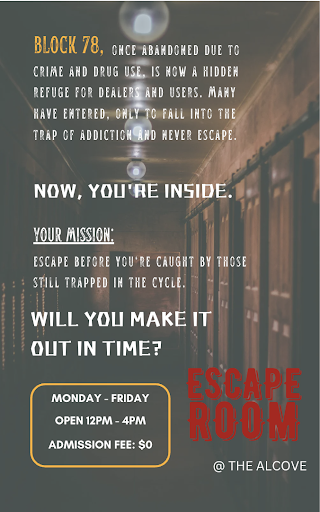
Participants find themselves in an abandoned HDB (Housing Development Board) block in Singapore, which has now become an unassuming hideout for drug users and dealers. Trapped within its walls, participants are primarily tasked to safely escape the room before they’re discovered by those still trapped in the cycle of addiction.
In the first room, participants are required to piece together a cipher, which will form a QR code that brings up a Gametize Challenge when scanned. On the platform, 2 multiple-choice questions (MCQ) will need to be answered, with related posters left around the room. Misinformation will be included in these posters to reflect the widespread falsehoods on drug use, emphasising the importance for IHL students to evaluate information critically, before making their decisions.
In the second room, set in a living room, participants will discover pieces of a diary, which they have to reorder in chronological order. After reading the diary, participants are prompted to scan a QR code that opens a Reflection Challenge on Gametize. Participants are led to empathise and forge emotional connections with our in-game character, Mei Lin. This also exemplifies their role in emotionally supporting their friends, and deterring others from drug use.
At the end of the diary entry, participants are hinted to dispose of the drugs to attain the QR code to pass the stage. Questions in this stage are presented from the perspective of a drug dealer, allowing participants to recognise and discern enticement tactics.
As a bonus, a social challenge will be introduced on Gametize where participants post a motivational message or create a short video on their thoughts about drug prevention.
Finally, in the third room, participants will symbolically be on a rooftop, presented with a hypothetical scenario and choice to make regarding drugs as a form of vice. Participants receive immediate feedback through Gametize about the potential consequences of their decisions and earn points based on their choice.
The final lock on the fire escape door can only be opened by a QR code, which consists of MCQs based on past information gathered throughout the escape room.
Marketing Collaterals:

2. REFLECTION
Our Journey: Crafting an Anti-Drug Escape Room Experience
Initial Understanding and Growing Awareness
When we first envisioned our anti-drug escape room, our understanding of substance abuse was limited. We knew the dangers but hadn’t fully grasped the complexities of addiction and prevention. Through research and mentorship, we learned that effective prevention goes beyond simply saying “no.” It involves building resilience, critical thinking, and creating supportive environments. This deeper understanding inspired us to design an experience that is both informative and thought-provoking.
Navigating Sensitive Topics
As we developed the content, we realised the importance of addressing drug abuse with sensitivity and respect. Rather than relying on fear-mongering, we focused on providing accurate information and fostering empathy. With our mentors’ guidance, we aimed to destigmatize addiction, viewing it as a health issue rather than a moral failing. This perspective shaped our narrative, allowing the escape room to promote understanding rather than judgement.
Understanding Project Limitations and Impact
We recognized that our escape room alone couldn’t solve the issue of drug abuse, but it could contribute to a larger prevention effort. Our goal became sparking conversations, challenging assumptions, and encouraging participants to seek more information. We hoped to create a catalyst for ongoing discussions around drug prevention.
Looking back, we’re proud of the educational tool we’ve developed. Throughout this journey, we’ve learned about interactive learning, thorough research, and how engaging experiences can address serious issues. While our escape room is just one step, we believe it can have a meaningful impact by sparking dialogue on drug prevention and empowering individuals to make informed choices.
Credits: Russell Foo (Leader), Shervonne Lee En Hui, Lok Qing, Riya, Russell Chan, Luke, Cai Ying