
Gamification and AI for Caregivers: The Garden Angels with Moral Home

1. Highlighting 6D Playbook
Define the Problem
To facilitate resolving this problem statement, we came up with 3 goals that we wanted our application to achieve:
- Sustained app engagement with users
- Deeper emotional connection to Moral Home
- Robust, inclusive and supportive caretaker community
Determine Goals
Taking inspiration from Gametize’s 6D Framework, we based our designs to fit our identified problem statement. Moral Home’s caregivers are currently having trouble assimilating into their new work and living environments.
Relocating from their home countries spanning across South-east Asia(SEA), they are often met with struggles that include but are not limited to: emotional stress, fatigue, social isolation etc. Their struggles could implicate the quality of care in which they provide to the aged, and this would lead to a negative experience for both caregiver and beneficiary.
To ease their struggles, we wanted to help the caregivers associate Moral Home as their new home far from home. Taking the role of the creatives team, we recognized that we needed to be the glue that combines the works of the other 5 teams in order to create an aesthetically pleasing application for the caregivers to utilise.
As such, we identified our problem statement: To unify the different pillars to create an accessible, resource-filled platform for all Moral Home foreign caregivers.
Decide Target Behaviours and Emotions
Community Building & Active Assimilation (Real-World Behaviour): Prompt caregivers to apply basic English navigation and wellness tips in their daily lives to smoothly adapt to Singapore and connect with peers across diverse backgrounds.
Belonging & Reassurance (Target Emotions): Elicit a feeling that Moral Home is a supportive “home far from home” and foster a sense of protection through the “Garden Angels” theme as caregivers navigate their new beginnings.

Profile Players
Foreign Caregivers Relocating from Southeast Asia (Demographics): The primary players are foreign caregivers from diverse backgrounds across Southeast Asia (SEA) who have relocated to Singapore to work at Moral Home.
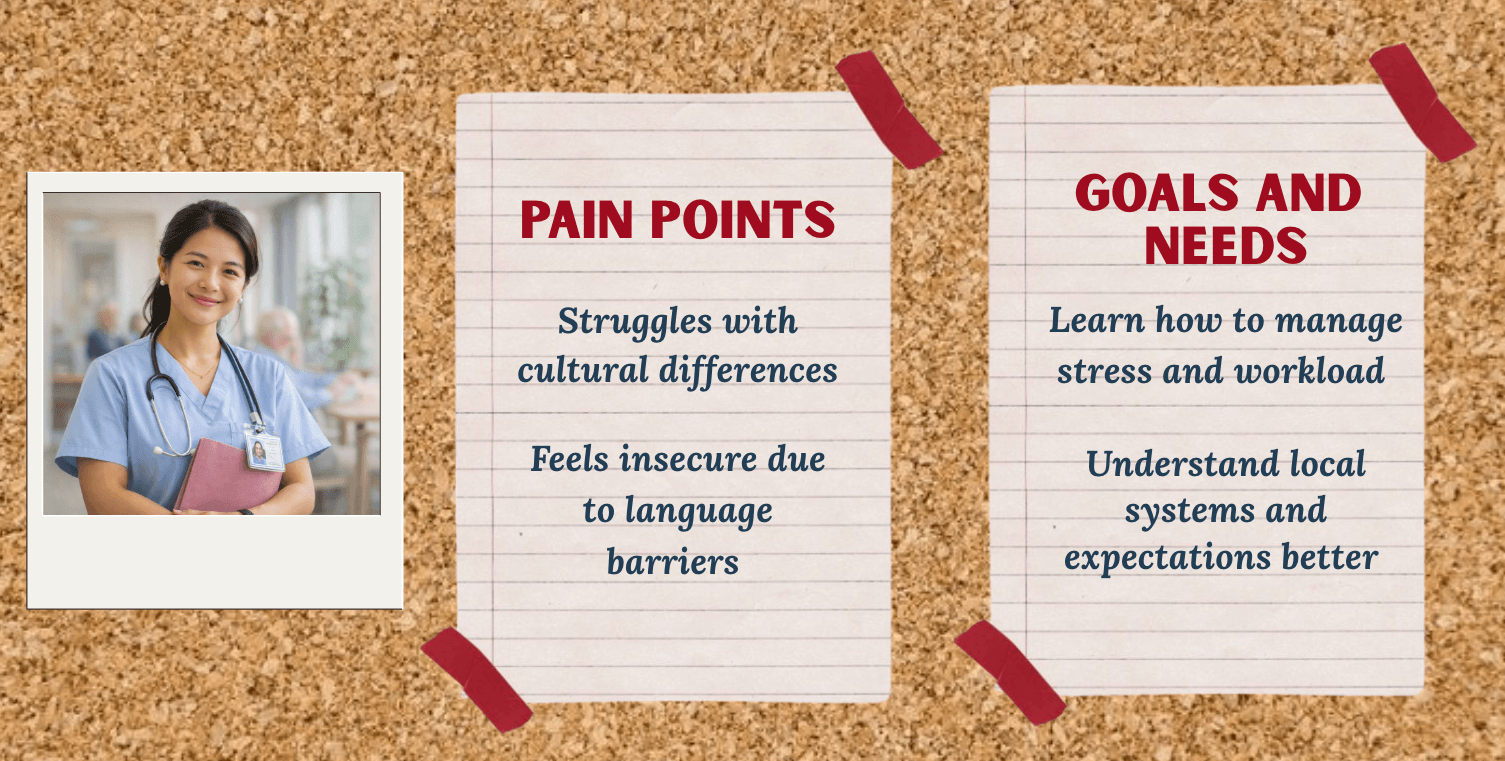
Vulnerable to Relocation Stress & Isolation (Player Pain Points): Players face challenges such as emotional stress, fatigue, and social isolation due to adapting to a new work and living environment, which can impact their well-being and caregiving quality.
Motivated by Low-Barrier, Supportive Engagement (Player Needs & Preferences): They require an accessible, non-intimidating platform built with basic English sentences (avoiding heavy jargon), simple visual rewards, and a warm, non-competitive theme to help them feel guided rather than tested.

Design Gamification Strategy
With Moral Home’s caregivers spawning from diverse backgrounds, we understood the need for a platform that integrates these different diversities together. Following Moral Home’s objectives of creating a garden theme, users would be exposed to a garden overlooking the different pillars.
These pillars are resonant to different types of flowers. Dubbing our pillars the “Garden Angels”, we wanted a catchy hook that highlights to users that this application is akin to guardian angels helping them navigate their new beginnings in Singapore. Our Garden Angels include:
- Luma the Lotus (Culture Pillar) – a flower symbolic of resilience and growth
- Flex the Bamboo (Physical Wellness Pillar) – symbolic of strength and adaptability
- Oria the Orchid (Exploring Singapore) – the national flower of Singapore
- Lavi the Lavender (Personal Finance) – a symbol of balanced wealth
- Zina the Zinnia (Mental Wellness) – symbolic of emotional resilience and self-remembrance


Diagnose and Analyse Content
Using this framework in collaboration with the other 5 teams, we created an interface that resembled a garden. Through thorough understanding of Gametize’s backend platform, we were able to merge the contents of the other 5 pillars to form one integrated application that is easy to use. The creation of our characters and visuals were mainly created using generative AI, in order to meet tight deadlines. However, we ensured that the prompts to initiate did not compromise on the quality of the artwork, and this is reflected in the consistent artstyle throughout all the pillars. In order to maintain the garden-like aesthetic throughout the application, we used a color theory app to determine a consistent color scheme associated with floral colors.
To further expand our outreach, we have also launched an Instagram page for our project as well. We created carousel posts using Canva, with each post explaining different variants of flowers, the inspiration behind these characters and also Moral Home’s humble beginnings. We wanted to contextualize the creation behind our application in order for users to understand our intentions.
Embedded within our application includes a reward system, along with informative resources that would ideally help to navigate caregivers in their first steps into Singapore. We wanted to include a reward system in order to maintain user engagement, and ensure that the quality of our resources was a priority. More importantly, we want this to be an application that caregivers could reliably depend on in their formative months here. We hope to be their beacon to help manage a natural transition in Singapore society, and we have attempted to make understanding of our application simple through using basic English sentences instead of jargon.

2. Inspiration for this Project
Collaboration is the core of this project with Moral Home. Collaboration in a sense, requires working with other teams across the module, as each team is in-charge of a specific area of the Gametize platform. Given that collaboration is such a big part of this project, success in managing group allocated tasks, roles and responsibilities will greatly bring much clarity and direction, not only to our group in-charge of socials but as a whole to the class.
Team dynamics is a crucial part of whether a project will be successful, not in terms of quantifiable goals, but rather intangible relationship building amongst your team and externally with other teams and stakeholders. Having a diverse group of people in your team has both positive and negative effects. Let’s break it down, positively people can contribute based on different life experiences. In our group, we come from different backgrounds, countries and disciplines. There are business, integrative studies and social science majors in our group, each being able to provide unique perspectives on how they see things.
3. Our Learnings
Working Styles and Teamwork Process
Our group adopted a collaborative structure where responsibilities were divided among smaller sub-teams based on the different components of the report. Each member focused on specific tasks aligned with their strengths, allowing the team to work efficiently while ensuring all aspects of the project were addressed. In that way, we each provided skills that complemented one another making the work more collective and collaborative rather than individualistic. The division of labour enabled the team to progress on multiple aspects of the project simultaneously while still maintaining a shared responsibility for the final outcome.
CREDIT:
Tan Ethan
Shruti Rajesh Gogri
Lennon Wentz
Valerie Isabelle Hartono
Bay Xuan En Hayley
Ryan Wong Zheng Jie
Ng Wei Feng, Gary
1. Play the game first.
2. Use the Template game for your own initiatives.