
Gamification and AI for Caregivers: Personal Finance with Lavi!
1. Highlighting 6D Playbook
Define the Problem
Singapore is home to a growing number of foreign caregivers, with foreign domestic Workers making up a significant portion of the workforce. However, many of these individuals lack financial literacy, leaving them vulnerable to financial stress and scams. Despite working hard to support their families, many caregivers struggle with:
- Budgeting and managing expenses
- Choosing safe remittance option
- Identifying scams and fraudulent schemes
Research shows that 74% of migrant domestic workers are financially excluded, with many not using formal banking systems. At the same time, reports have highlighted a rising number of loan scams and financial fraud targeting caregivers, exposing them to severe financial stress and vulnerability.
This creates a critical gap. While systems like NGOs provide support, there is still a lack of scalable behavioural learning tools that allow caregivers to practice real-life financial decisions.
Money Maze was designed to address this gap by transforming financial literacy into an interactive, safe, and engaging experience.
Determine Goals
Our Mission
To empower every caregiver with the tools, knowledge, and confidence to achieve financial independence and security.
Objectives
By the end of the gamified experience, the initiative aims to:
- Strengthen financial literacy (budgeting, saving, remittance decisions)
- Reduce vulnerability to scams
- Build financial confidence and independence
- Improve caregivers’ well-being and job performance
Ultimately, the goal is not simply to teach financial concepts, but to enable real behavioural change and long-term resilience.

Decide Target Behaviours and Emotions
To achieve this, we designed the experience to influence both actions and emotions, recognising that behaviour change is not purely rational, but deeply psychological.
Target Behaviours:
- Manage money wisely
- Compare remittance options
- Identify scams and take action
- Seek help from trusted sources
Emotional Outcomes:
- Confidence in handling finances
- Sense of control and independence
- Reduced fear of scams
- Motivation to support family effectively
Motivation Design
Extrinsic Motivation
- Fear of losing salary → “If I don’t learn, I may lose everything”
- Desire to send more money home → tangible financial outcomes
Intrinsic Motivation
- Sense of competence → “I am becoming smarter with money”
- Independence → “I can survive and succeed here”
- Psychological safety → learning through mistakes without real consequences
This dual-layer approach ensures that learning is not only understood cognitively, but also felt emotionally and internalised behaviourally.
Profile Players
Our primary users are foreign caregivers in Singapore, who:
- Possess basic English proficiency
- Are highly motivated to support their families
- Have limited exposure to formal financial education

Khin and Juan represent caregivers at different stages of their financial journey, yet both face vulnerabilities due to gaps in practical financial knowledge.
- Khin (beginner) → learns foundational systems and builds trust
- Juan (experienced) → strengthens scam awareness and response
Money Maze meets users where they are, transforming financial literacy into a lived experience.
Design Gamification Strategy
At the core of Money Maze is a simple yet powerful design philosophy: “Do not just tell users what to do, let them experience it.” The platform is built as a real-life simulation game where users actively
- Make financial decisions
- Experience consequences
- Learn from mistakes in a safe environment
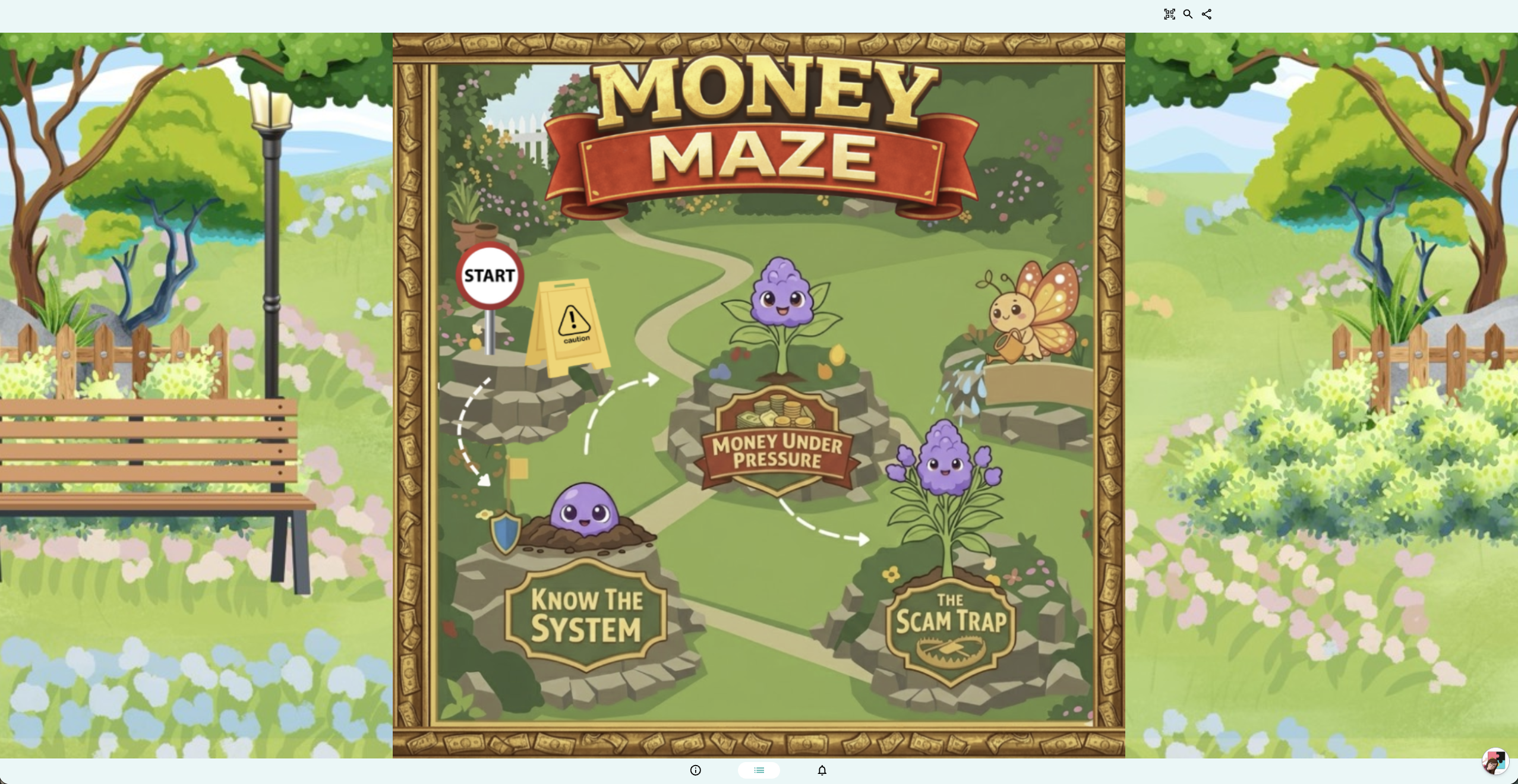
Scene 1: Knowing the System
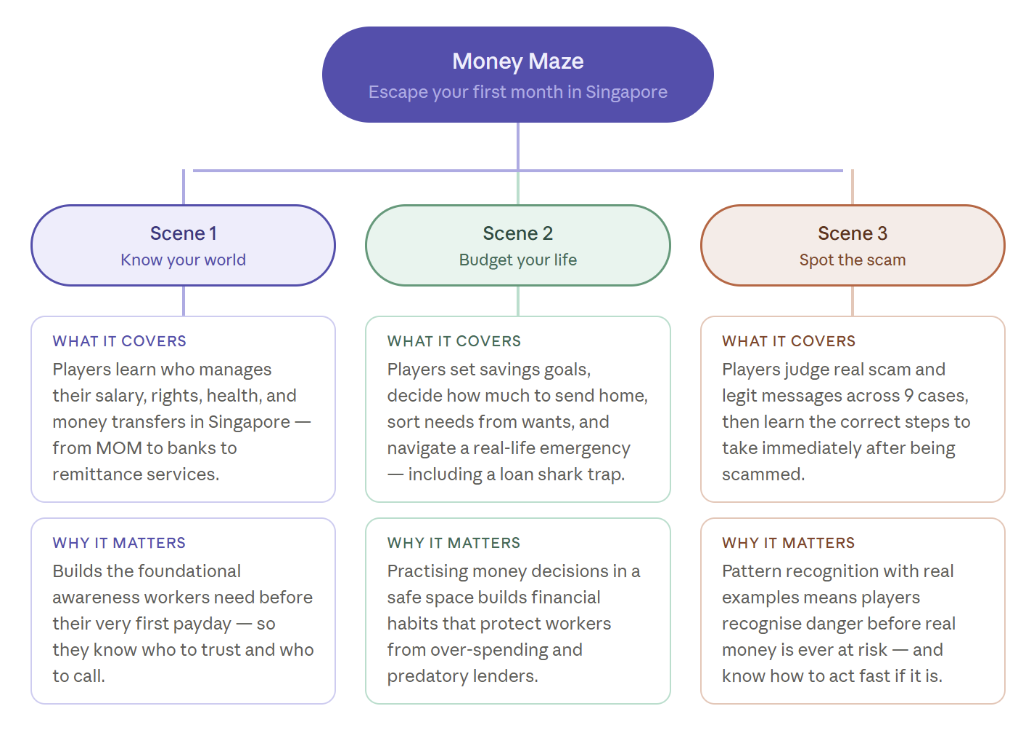
Users are introduced to the financial ecosystem in Singapore. They learn about banking systems, remittance services, and where to seek help when needed. By comparing remittance fees and understanding available options, users begin to build financial awareness and confidence.
Scene 2: Money Under Pressure
Users are placed in realistic situations where they must manage their income. They learn to set SMART financial goals, practice budgeting, differentiate between needs and wants, and navigate risky situations such as loan shark traps. This scene focuses on strengthening decision-making skills and building financial resilience under pressure.
Scene 3: The Scam Trap
Users encounter common scam scenarios where they must determine whether situations are legitimate or fraudulent. Incorrect decisions trigger consequence-based disruptions, reinforcing the seriousness of scams while providing learning opportunities. Users also learn appropriate emergency response actions, equipping them with practical skills to handle real-world situations. These scenarios simulate real-life pressures, making the learning experience practical, memorable, and emotionally engaging.
Engagement:
To further enhance retention, the game incorporates a strong narrative hook: “Many people lose their hard-earned salary not because they are careless, but because no one taught them how to protect it.” This framing shifts the narrative from blame to empowerment, making the learning experience more relatable and motivating.
Additionally, inclusion of Junus, the Financial Expert, provides guidance, reassurance, and reinforces key lessons throughout the journey. This human element helps build trust.
The overall design prioritises simplicity and accessibility. The game is short, mobile-friendly, and intuitive, ensuring that users can easily navigate the experience without feeling overwhelmed. By reducing cognitive load, the platform makes financial learning approachable and engaging for users with varying levels of familiarity.

Diagnose and Analyze Content
To ensure the effectiveness of the platform, we conducted user testing and gathered feedback to refine the experience.
Key Findings
- Majority felt more confident in financial decision-making after playing
- Users reported improved financial knowledge
- Most agreed the game would be beneficial for caregivers in Singapore
At the same time, user testing revealed several areas for improvement. Some users found it difficult to navigate the game, while others were unsure how to begin or progress through the experience.
In response, we made some improvements. Clear navigation instructions were added to guide users, tutorial features were introduced for each game segment, and friction was reduced through simplified interactions such as auto-copy functions. These improvements made the platform more intuitive and user-friendly.
This iterative process ensured the experience remained accessible and user-friendly.
2. Inspiration for this Project
Money Maze was inspired by a simple idea: Financial literacy should not just be taught, it should be experienced.
Through our interactions with caregivers, we observed that while many are willing to learn, traditional methods such as workshops and lectures often fail to engage them or translate into lasting behavioural change. Learning remains theoretical rather than practical.
By combining gamification with real-life simulation, we created a platform where learning becomes interactive, mistakes become safe lessons, and knowledge becomes actionable behaviour. Money Maze transforms financial literacy into a lived experience, allowing caregivers to practise, fail, and grow in a supportive environment.
3. Our Learnings
Through interactive simulations:
- Caregivers became more confident and aware
- Learning became less intimidating and more accessible
- Financial decisions became something they could practise, not fear
From an industry perspective, we learnt that
- What may seem “simple” to us may not be simple to users
- Designing with empathy is very important
- Continuous feedback is essential to improving user experience.
From a team perspective, we gained valuable insights into collaboration and communication. Working in a self-managed team required active listening, compromise, and the ability to integrate diverse perspectives. Ultimately, designing for impact requires not only analytical thinking, but also empathy and adaptability.
CREDIT:
Attili Punitha Bhanu, Ong Jing Kai, Qian Zhibin, Sherryn Marvella Fan, Toh Ting Hui, Wee Lu Xuan
1. Play the game first.
2. Use the Template game for your own initiatives.